Sunday, May 25, 2014

Wednesday, May 21, 2014
Twitter Narrative Summaries
Please post your Twitter Narratives Summary (or a link to the narratives) here in the comment section of this blog entry.
Monday, May 19, 2014
Tues, May 20
In preparation for your TEDTalk presentations (May 29), we will be researching the best options for video software. Please see the assignment sheet below. You will be posting your work on prezi and working as a group.
Please be ready to present your findings on Thursday, May 22.
Wednesday, May 14, 2014
Thurs. May 15
We began today by reviewing Final Presentations (bad TEDTalks) and looking over the rubric. Specifically, I want to emphasize the difference between the video presentations that you will be doing and the in-person presentations you are used to. I want you to be especially aware of your audience and how to keep them engaged. Also be aware of yourself as an audience member and attempt engagement with the video.
I will give you some class time to work on this--though it is likely that you will need to work outside of class to complete the project.
I also introduced our Twitter Narrative Review (in lieu of a final exam). There is a group component and an individual component, which again, I will give you time in class to work on--though be prepared to do work outside of class as well.
We reviewed the concept of the hypertext essay, comparing it to the traditional linear essay. We then performed a class exercise imagining how the Radiolab "War of the Worlds" podcast (a kind of audio linear essay) would look if it were turned into a hypertext essay.
Comparing and contrasting the different methods, you made some very smart observations: the linear essay was primarily focused on "deep focus" while the hypertext essay had a "wide focus." We talked about what this suggested about audience and you recognized that the linear essay would appeal to an audience that shares a similar focus/interest while the hypertext essay would be much better for a general academic audience, and much more likely to attract/maintain attention.
Assignment:
Continue work on your Twitter Narrative
Continue work on your Final Presentation
I will give you some class time to work on this--though it is likely that you will need to work outside of class to complete the project.
I also introduced our Twitter Narrative Review (in lieu of a final exam). There is a group component and an individual component, which again, I will give you time in class to work on--though be prepared to do work outside of class as well.
We reviewed the concept of the hypertext essay, comparing it to the traditional linear essay. We then performed a class exercise imagining how the Radiolab "War of the Worlds" podcast (a kind of audio linear essay) would look if it were turned into a hypertext essay.
Comparing and contrasting the different methods, you made some very smart observations: the linear essay was primarily focused on "deep focus" while the hypertext essay had a "wide focus." We talked about what this suggested about audience and you recognized that the linear essay would appeal to an audience that shares a similar focus/interest while the hypertext essay would be much better for a general academic audience, and much more likely to attract/maintain attention.
Assignment:
Continue work on your Twitter Narrative
Continue work on your Final Presentation
Monday, May 12, 2014
Tuesday, May 13
We started today by finishing our review of vlogs and video diaries. We determined that the purpose of the video diary is to document/record one's own experience and make it public. We also decided that the audience--while it is available to the public--is mostly the diariest himself or herself. It is largely "written" for the self. By contrast, the purpose of the vlog is to entertain and attract as large an audience as possible. We reviewed the different formats different vlogs use to entertain: the rant (funny complaint), commenting on already-popular internet videos, mimicking popular videos/video games/characters.
While the purpose and audience of the vlog and video diary are different, the elements they have in common is that they are similar media formats. Both would also be useful in creating a dynamic, complex Twitter Narrative.
While the purpose and audience of the vlog and video diary are different, the elements they have in common is that they are similar media formats. Both would also be useful in creating a dynamic, complex Twitter Narrative.
I introduced your Final Presentation Assignment, described in the link to the right. After class, it was proposed that you do this as a group, rather than individually, which I agreed to. We will discuss the stages of this on Thursday, though I would like everyone--as an individual--to think of 3 possible subjects for your presentation that sound complex.
We then moved on to talk about hypertext and how it is different from print text. We determined that print text is linear--you open a book and start at the first page, then move to the second, then the third. It is limited--and navigated--by space.
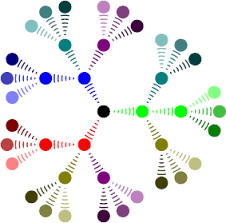
By contrast, hypertext is not linear, but nodal. Each node is a point of connection that branches further and further away from the original center.
We practiced this idea using a Google Doc where you identified the different nodes. Many of you identified proper nouns (or people and place names), which is good. I also added ideas as nodes (such as "war draft" and agoraphobia). These proved to be useful nodes with many points of connection. Even the year 1979 proved to be useful. It had many connections, but one of these connections was the decision to compensate Kent State victims and their families for their loss. This naturally connected to the Kent State shootings, which connected to the Cambodian Involvement. Etc. etc.
For your assignment, I asked you to identify as many nodes as you can in your own essays that you posted to your blog for today's class.
Assignment:
- 3 possible topics for your faux TEDTalk
Check blog links on class blog home page (make sure these links are active and linking to the correct site so that you can get credit for your work)
- Continue work on Twitter Narrative (think of vlogs and video diaries)
- Find nodes in your blog essay
Wednesday, May 7, 2014
Thursday, May 8
Today we began working with vlogs, the video log. I asked you to look at a few examples and answer the following questions on our Google Doc "Using Vlogs."
We examined a few of these vlogs, noting that their purpose was largely entertainment. We analyzed what made them funny and how they worked.
Some vlogs made use of editing to be humorous.
- cutting/omitting material
- editing voice to sound humorous
Some vlogs manipulated logic
- playing with definitions
- playing with categories
- playing with logical assumptions and conclusions
Those whose vlog examples we did not view today, we will examine on Tuesday. In the meantime, I would like you to consider how you might use vlogs to further your own Twitter Narratives. Remember that the purpose of the Twitter Narrative is not only to tell a story, but to tell a good story, one with many layers of narrative and many layers of media.
For our next class, we will be examining hypertexts. To do this, we will need material. I would like you to bring in your own material: a completed essay that you wrote for this course or for a course other than this one.
Assignment:
Blog post: how you might use vlogs for your Twitter Narrative?
Blog post: your completed essay (any essay you choose, this can be from another course).
Explain what is wonderful about this vlog. Why is it so popular?
How does the vlogger promote his/her work?
What elements of this vlog could you use?
How would it promote your Twitter Narrative?
Some vlogs made use of editing to be humorous.
- cutting/omitting material
- editing voice to sound humorous
Some vlogs manipulated logic
- playing with definitions
- playing with categories
- playing with logical assumptions and conclusions
Those whose vlog examples we did not view today, we will examine on Tuesday. In the meantime, I would like you to consider how you might use vlogs to further your own Twitter Narratives. Remember that the purpose of the Twitter Narrative is not only to tell a story, but to tell a good story, one with many layers of narrative and many layers of media.
For our next class, we will be examining hypertexts. To do this, we will need material. I would like you to bring in your own material: a completed essay that you wrote for this course or for a course other than this one.
Assignment:
Blog post: how you might use vlogs for your Twitter Narrative?
Blog post: your completed essay (any essay you choose, this can be from another course).
Monday, May 5, 2014
Tuesday, May 6
We began class by talking about the Radiolab transcript of "War of the Worlds" that you read for today. Discussing the rhetorical situation, we determined that there were several layers and mediums used to tell this story:
Novel (1897) - the original novel by H.G. Wells about a hostile alien invasion
Radio (1938) - a screenplay of the original novel by Orson Wells, broadcast to the public
Podcast (2008) - a story about the radio program, examining the public response
When I asked why the podcast producer Jad Aboumrad chose to use these multiple layers, Zoe answered that it makes the story more interesting. This is exactly right. By making a story more rich and complex (though not necessarily complicated), we create a better story more likely to engage the audience.
I asked you to think about different ways you might layer your own narratives. One way you might do this is the way you tell the story. We listed several kinds of media together:
Continuing our discussion of interest, we discussed that the reason "War of the Worlds" had such a powerful affect upon its 1938 audience was the way that it reflected social anxieties of the time. Americans in 1938 were about to go into war and had good reason to worry about foreign invasion. A story about alien invasion reflects this anxiety of foreign invasion in powerful and effective ways.
Using Google Docs, I asked you to determine who you audience was and what they were anxious about or happy about. You came up with some really great concerns:
these are very specific issues, that are directly related to your topic. This is great.
Some of you had more general social concerns
The purpose of doing this is to engage your audience by creating
1) plots that appeal to them
2) discussions that appeal to them.
Remember: an audience will not be interested in a discussion that is only about characters or only about a place. You should have your characters talk about real interests and concerns.
Assignment:
Respond on your blog: How can you use different kinds of media to create a layered narrative in your Twitter narrative?
And keep working on your Twitter narrative. Every day, each character should contribute 2-3 significant tweets that develop the story.
Novel (1897) - the original novel by H.G. Wells about a hostile alien invasion
Radio (1938) - a screenplay of the original novel by Orson Wells, broadcast to the public
Podcast (2008) - a story about the radio program, examining the public response
When I asked why the podcast producer Jad Aboumrad chose to use these multiple layers, Zoe answered that it makes the story more interesting. This is exactly right. By making a story more rich and complex (though not necessarily complicated), we create a better story more likely to engage the audience.
I asked you to think about different ways you might layer your own narratives. One way you might do this is the way you tell the story. We listed several kinds of media together:
- print/online - you are reading text
- visual - you are reading images
- audio - you are reading sounds
- mixtures of the two things:
- audio-visual (like a film)
- print and visual - infographic
How might you use these things in your own narrative?
Interest
Continuing our discussion of interest, we discussed that the reason "War of the Worlds" had such a powerful affect upon its 1938 audience was the way that it reflected social anxieties of the time. Americans in 1938 were about to go into war and had good reason to worry about foreign invasion. A story about alien invasion reflects this anxiety of foreign invasion in powerful and effective ways.
Using Google Docs, I asked you to determine who you audience was and what they were anxious about or happy about. You came up with some really great concerns:
- the company selling Chinese buns determined that their audience might be concerned about food safety
- the cosmetic company determined their audience might be concerned about organic ingredients and animal testing
these are very specific issues, that are directly related to your topic. This is great.
Some of you had more general social concerns
- the missing Malaysian flight MH370
- I asked you to examine the meaning and effectiveness of #BringBackOurGirls
The purpose of doing this is to engage your audience by creating
1) plots that appeal to them
2) discussions that appeal to them.
Remember: an audience will not be interested in a discussion that is only about characters or only about a place. You should have your characters talk about real interests and concerns.
Assignment:
Respond on your blog: How can you use different kinds of media to create a layered narrative in your Twitter narrative?
And keep working on your Twitter narrative. Every day, each character should contribute 2-3 significant tweets that develop the story.
Subscribe to:
Posts (Atom)